America’s 250th Anniversary

In 1776, the “Committee of Five” listed the reasons for the Continental Congress’ vote to separate from Great Britain. Almost 250 years later, the rights identified as “unalienable” are also enduring. This page contains resources for teaching and learning about how the Declaration of Independence laid the foundation for our system of justice and the protections that we enjoy today.

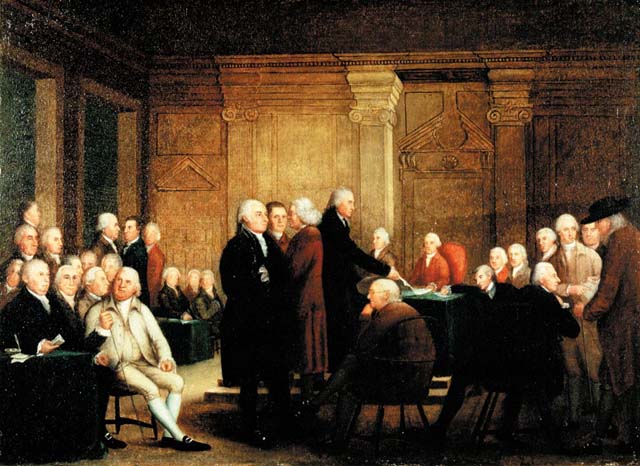
Painting of 25 - 30 men dressed in long coats and wigs in a room. Four men stand in the center of the image. The tallest of them is handing a piece of paper to a man seated near a table reaching to take the paper.

Congress Voting Declaration of Independence by Robert Edge Pine / Edward Savage

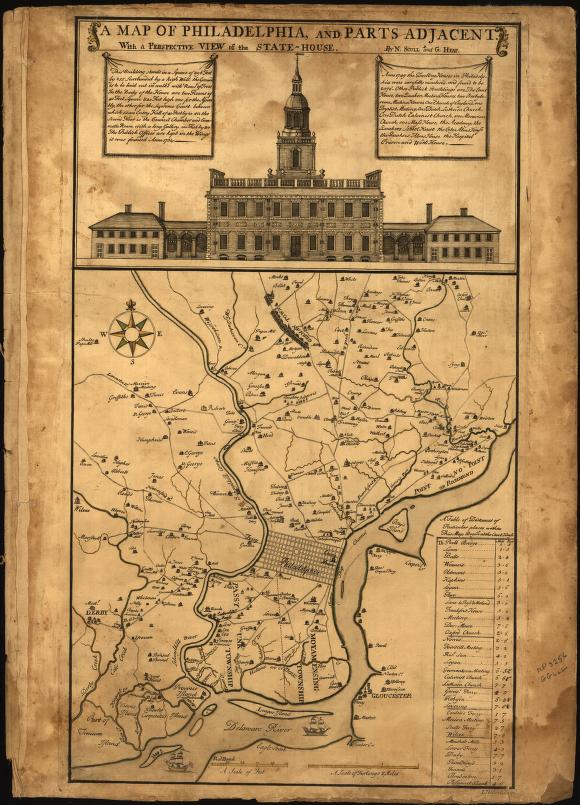
Map of Philadelphia and Parts Adjacent with perspective view of the State House in 1752

Philadelphia, 1752

A Short History

  • Colonial Beginnings

    The American colonies were governed under a variety of systems, including royal, proprietary, and self-governing charters, but many shared a common feature: local assemblies made up of elected representatives. While ultimate authority rested with the British Crown and Parliament, colonial governments often managed their own affairs, especially in matters of taxation and local laws. The executive branch, usually led by a governor appointed by the Crown or proprietors, was controlled from above, while colonial legislatures were elected by local property-owning citizens and exercised significant influence over laws and budgets. However, colonial courts often remained under the authority of the King. This experience with self-rule helped colonists develop expectations about representation and accountability. When tensions with Britain grew, these practices influenced the creation of new political structures based on elected legislatures, checks on power, and written constitutions. As a result, the system of colonial governance laid the groundwork for the democratic principles and federal structure later established in the United States government.

    Constituting America 250’s guest essayist, Tom Hand explains the differences in royal, charter, and proprietary colonies here: Royal, Self-governing, and Proprietary Colonies: Advancing from British Rule Toward American Independence
  • English Common Law

    English common law is used in governments all over the world, usually in places that were former British colonies, including America. Today, the United States legal system draws heavily on the common law system. However, elements of civil law can be found as well. English common law is based on judicial decisions and precedents, meaning that past court rulings guide how new cases are decided, while civil law relies on comprehensive written codes and statutes to determine legal outcomes. In the American colonies, common law was adopted from England and became the foundation of the U.S. legal system, especially in its reliance on case precedent and the role of judges in interpreting the law. However, elements of civil law also influenced certain areas, such as codified statutes and legal systems in the states. Together, these two systems contributed to a uniquely American legal framework that blends precedent with written law.
  • Judicial Rights

    Even though colonial courts were controlled by the King, people were guaranteed specific rights in court. These rights were originally enshrined in Magna Carta, a contract signed by King John and an assembly of barons in 1215, demanding that certain rights be recognized and written down. These included due process of law, freedom from arbitrary imprisonment, trial by jury, and other fundamental rights. This document inspired and informed the Founding Fathers when they wrote the Declaration of Independence, the United States Constitution, and the Bill of Rights.

    While the landscape of colonial government – an executive governor, a bicameral legislature, and courts appointed by the King – was shaped by English tradition, those rights, and the judiciary, would be tested in 1770 with the Boston Massacre.

    In 1770, English soldiers fired their guns into a crowd of angry colonists in Boston, killing five and injuring others. No one had faith in a fair trial for the soldiers. However, John Adams, founding father and future president, risked his own reputation and took their case. He staunchly believed in the unalienable right to a fair trial, including the right to counsel. This belief continues to shape our justice system.

    Tensions continued to mount in the colonies, and in 1775, the American Revolution began. The colonists issued the Declaration of Independence, which listed their grievances and justification for their separation from England. Many of those grievances were later addressed in the Bill of Rights.

    The details of the Boston Massacre Trial are outlined in this article, published by the National Park Service.
  • Modern Connections

    The Declaration of Independence and the later frameworks of the United States Constitution and the United States Bill of Rights are deeply connected expressions of American political philosophy. While the Declaration is not law, it establishes the moral foundation—especially the principles of natural rights, equality, and resistance to tyranny—that the Constitution and Bill of Rights later translate into enforceable legal guarantees. Nowhere is this connection more evident than in the role of the judiciary and the rights of the accused.

    The Declaration asserts that all individuals possess unalienable rights such as life, liberty, and the pursuit of happiness, and it criticizes the British crown for denying colonists fair legal protections, including trial by jury. These grievances directly shaped the Constitution’s creation of an independent judiciary. Article III establishes a federal court system designed to be insulated from political pressure, ensuring impartial interpretation of the law. This reflects the Declaration’s insistence that legitimate government must safeguard individual rights rather than violate them.

    The Bill of Rights, particularly Amendments IV through VIII, enshrines these ideals by protecting the rights of the accused. Guarantees such as protection against unreasonable searches and seizures, the right to due process, the right to a speedy and public trial, the right to legal counsel, and protection against cruel and unusual punishment all stem from the same philosophical core as the Declaration. They ensure that the government cannot arbitrarily deprive individuals of liberty—addressing the very abuses listed in 1776.

    Today, the judiciary serves as the bridge between these founding ideals and everyday legal practice. Courts interpret constitutional protections in light of evolving circumstances, often invoking the spirit of the Declaration when considering fundamental rights. Landmark decisions on due process and fair trials demonstrate how the judiciary continues to uphold the principle that government power must be constrained to protect individual dignity.

    Together, these foundational documents form a system in which the judiciary plays a central role in ensuring that the rights of the accused—and all citizens—remain protected in accordance with the nation’s founding ideals.


What to Read

  • Ages 3 - 7

    • Red, White, and BOOM! By Lee Wardlaw
    • Democracy for Dinosaurs By Laurie Krasny Brown
    • That Rule Doesn't Apply to Me By Julia Cook
    • What Is America? By Michelle Medlock Adams
    • John, Paul, George, and Ben By Lane Smith
  • Ages 6 - 11

    • Revolutionary Mary By Karen Blumenthal and Jen McCartney
    • What is the Declaration of Independence? By Michael C. Harris
    • The Side-By-Side Declaration of Independence By David Miles
    • Magic Tree House: Revolutionary War on Wednesday By Mary Pope Osborne
    • The Journey of the One and Only Declaration of Independence By Judith St. George
  • Ages 10 - 15

    • Lafayette! By Nathan Hale
    • King John and Magna Carta By L. du Garde Peach
    • The Declaration of Independence By Elizabeth Raum
    • Worst of Friends: Thomas Jefferson, John Adams and the True Story of an American Feud By Suzanne Tripp Jurmain
    • Woods Runner By Gary Paulsen
  • Ages 16 +