

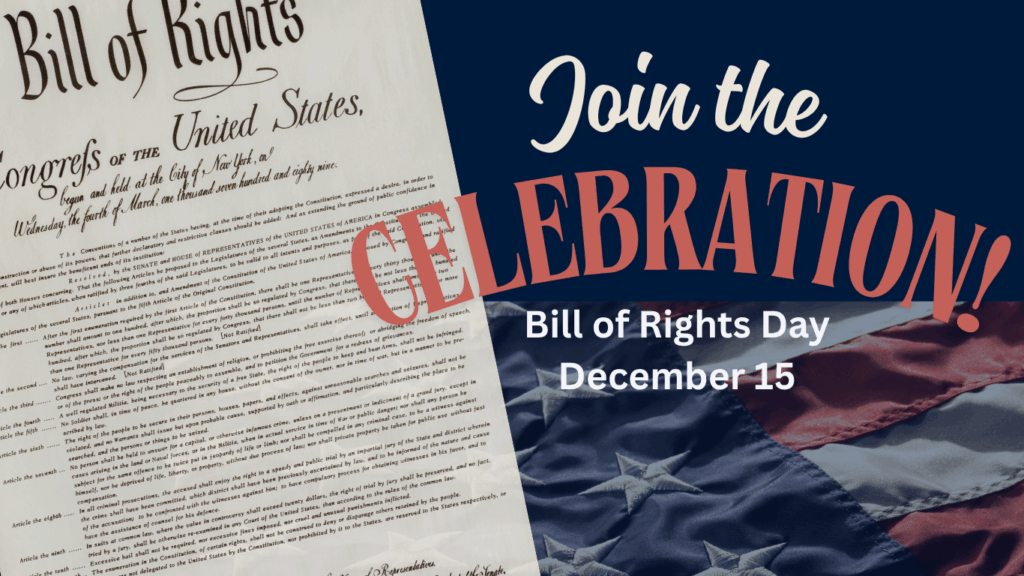
December 15 marks the 234th anniversary of the ratification of the Bill of Rights – the first ten amendments to the Constitution. Without these amendments (corrections or additions to a document), many of the states would never have agreed to the Constitution. The Bill of Rights fulfilled the promise enshrined in the Declaration of Independence: the idea that citizens are due individual rights simply because they are human. How will YOU celebrate this significant day in human history?

Click on the image to explore more about each of the first ten amendments
Individual Rights
The Declaration of Independence set forth a daring proposition – the idea that all humans, not just the nobility, are born with rights. The actual details, though, were vague. In 1791, what it meant to have a right to life, liberty, and the pursuit of happiness became much clearer when the Bill of Rights officially became a pillar of our nation’s foundation. In just ten short paragraphs, James Madison articulated specific protections for the people from a tyrannical government.
Resources for Teaching the Bill of Rights in the Classroom
These short lessons and activities will help your students build foundational knowledge about the concepts of rights (for younger classes) and the rights contained in the first ten amendments.
- My Rights Hand Lesson Plan (Grades K-2)
- Illustrated Bill of Rights Lesson Plan (Grades 3-5)
- Do You Know Your Bill of Rights? Lesson Plan (Grades 4-5; 6-8)
- The Bill of Rights and Civil Liberties (Grades 9-12)
As future citizens, one of the most important responsibilities your students will have is jury duty. Try these activities to give them practice at the critical thinking and civil dialogue skills necessary to be a thoughtful and active participant in their democracy (while getting an in-depth exploration of another important right).
-
- Speak Up! The Case of Tinker v. Des Moines (Grades 3-5)
- Make a Case: A Student Expression WebQuest (Grades 6-12) Teachers: Click “Use Template” to make your own copy for distribution to your class
Resources for Teaching the Bill of Rights at Home
December is busy at school AND at home! Bill of Rights Day may not be the holiday that takes center stage but consider that we celebrate Bill of Rights Day in a month filled with holidays that evoke enlightenment, justice, and generosity. Connect your family’s traditions with a larger civic identity. Here are some questions to get you started:
-
-
- When we turn on a light, it chases away the dark. If a right (like the right to be safe) is a bright light, what is the “darkness” that might try to put that light out? (Someone being unfair, bullying, not following the rules).
- Many people celebrate Hanukkah and Diwali because they won the right to practice their traditions freely. What right do we have in our community that allows you to celebrate your own favorite holiday?
- During giving holidays, many families donate food or winter coats to people in need. If everyone has the right to have enough food and warm clothes, how does being generous help protect those basic rights for others in our community?
- If you volunteer to pick up trash, or help a neighbor rake leaves, you are a “Community Helper.” How does this act of generosity protect the right of everyone to live in a clean and beautiful neighborhood?
- You have a right to use the playground equipment. If you choose to let someone go in front of you on the slide, are you giving up your right, or are you being generous while still respecting everyone’s right to play?
-