


What’s Wrong with this Court?
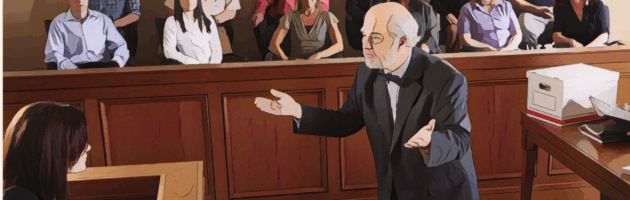
This two-part lesson can be completed individually or in groups. The first part walks students through the content on judicial independence found on the Judicial Learning Center’s web page. This portion could be completed as homework in preparation for the second part.
The second part uses a silly, fictious courtroom scenario, with 19 inaccurate statements. These statements sometimes target vocabulary, but also involve the trial process and judicial ethics. Students will use what they know about the judicial process, courts, and judicial independence to read the case and pick out the inaccurate statements. Once they are identified, students should note what is wrong with the statement and provide a correction in the space given.
Download the PDF
Corresponding Student Center Pages
Suggested Time Needed
2 class periods
- A: Understanding Judicial Independence
- B: What’s Wrong with this Court?
After completing this activity, students will:
- Understand the factors that guarantee the judicial branch’s independence.
- Apply the knowledge they have gained about the court process and judicial ethics to pick out inaccurate information.
- Have a greater understanding of the judicial process in general.
- Have a deeper understand of the reasons for some processes and procedures and recognize how they are related to judicial independence.
Guiding Questions
- What is in place to guarantee that judges are free from public opinion?
- What safeguards the independence of the judiciary from the president and Congress?
- How might the court system be different if judges were not independent from public opinion, or from the other two branches of government?
- How is the idea that the judiciary is independent related to the concept of “separation of powers”?
- What does it mean that judges are bound by the “rule of law, not of man”?
- How does the independence of the judiciary, and the judicial code of ethics, provide for all people to be treated equally and fairly before the court?
Missouri Grade Level and Course Level Expectations
- 9-12.GV.3.GS.D – Describe and give examples of how the constitutional principle of checks and balances limits the powers of government and leaders.
- 9-12.GV.4.GS.C – Compare the various processes pertaining to the selection of political leaders at the federal, state, and local level.
Place students into groups of 2, 3, or 4 depending on your class size.
Distribute the handout for part 1, and instruct students to go to the Student Center pages at https://judiciallearningcenter.org/about-federal-judges/ and https://judiciallearningcenter.org/judicial-independence/
Tell them to use the two web pages to complete the questions on the handout.
Allow time to complete. When finished, discuss the answers. Lead a discussion to include the following points:
- Judicial independence is a core concept of the American judicial system.
- The courts and judges are independent from public opinion because they are not elected.
- The courts and judges are independent from the other two branches because they can’t be fired in times of good behavior, and their salary can’t be reduced by the president or Congress.
- Because the courts and judges are independent, they are free to make decisions according to the law, even if those decisions might be unpopular.
- Federal judges are bound by the law, and by a strict code of ethics, which provides guidance for judges in maintaining their independence.
After summarizing part 1, distribute copies of the handout for part 2. Explain to students that they will be reading a brief scenario about a court case.
Explain that there are many errors in the summary, and their job is to find them all.
Allow time to complete. When finished, discuss the answers from the teacher guide.
Conclusion
Ask students to share their thoughts on the following:
- What exactly is judicial independence?
- How does judicial independence provide for all to be treated equally and fairly by the court?
Review the Guiding Questions
- What is in place to guarantee that judges are free from public opinion?
- What safeguards the independence of the judiciary from the president and Congress?
- How might the court system be different if judges were not independent from public opinion, or from the other two branches of government?
- How is the idea that the judiciary is independent related to the concept of “separation of powers”?
- What does it mean that judges are bound by the “rule of law, not of man”?
- How does the independence of the judiciary, and the judicial code of ethics, provide for all people to be treated equally and fairly before the court?
Understanding the Types of Cases
What is the difference between civil and criminal cases and how do you know if a case will be heard in state court or in federal court? In part 1, students will be asked to read and compare two current news stories and identify the key differences between civil and criminal lawsuits. This should be completed before any detailed instruction on the differences between civil and criminal cases. In part 2, students will use the Student Center webpages and/or a fact sheet to differentiate between federal and state court cases. The activities in this lesson can be assigned to students individually or in groups.
Corresponding Student Center Pages
Suggested Time Needed
1-2 class periods
Part 1 Downloads
Handout A – Article 1
Handout B – Article 2
Handout C – Comparing Criminal and Civil Lawsuits Student Chart
Handout D – Comparing Criminal and Civil Lawsuits Summary & Answer KeyPart 2 Downloads
Handout E – Fact Sheet: Comparing State and Federal Courts
Handout F – Comparing State and Federal Courts Student Worksheet
Handout G – Comparing State and Federal Courts Answer Key
Handout H – Case Scenarios
Handout I – Case Scenarios Answer KeyAfter completing this activity, students will:
• Have a deeper understanding of the characteristics of civil and criminal lawsuits
• Be able to pick out key differences in a news story, and determine the type of case from those clues
• Be able to compare and contrast federal and state jurisdiction in simple terms
• Apply knowledge of these differences to new situations by determining the jurisdiction of fictional scenariosGuiding Questions
• What are the main identifying components of a civil lawsuit?
• What are the main identifying components of a criminal lawsuit?
• How are civil and criminal lawsuits alike? How are they different?
• What is under the jurisdiction of the state court system? The federal court system?
• What is general jurisdiction? What is limited jurisdiction?Missouri Grade Level and Course Level Expectations
6-8
• 6-8.AH.1.GS.A – Analyze laws, policies and processes to determine how governmental systems affect individuals and groups in society in American History prior to c. 1870.
• 6-8.AH.3.GS.E – Apply the principles of rule of law, representation, separation of powers, checks and balances, and federalism to explain the purposes and functions of the Constitution.
• 6-8.AH.5.GS.B – Analyze federalism and popular sovereignty to explain peoples’ expectations of the role of government and their place in governance.9-12
• 9-12.GV.3.CC.D – Analyze the changing relationship between state and federal governmental powers.
• 9-12.GV.3.GS.A – Apply the concepts of due process of law, popular sovereignty, rule of law, representation, and federalism to explain the purpose and legacy of the Constitution.
• 9-12.GV.3.GS.F – Compare the structure and functions of local, state, and federal governments.Part 1 – Civil or Criminal?
- Explain to students that they’ll be reading about two different types of court cases, and that they’ll be asked to answer questions to help them understand the differences. Distribute copies of the 2 news stories (HANDOUT A & B) to all students and ask them to read both silently. You may prefer to group them in pairs to answer the questions. Don’t explain the differences between criminal and civil yet.
- Allow time for students to read both articles.
- Distribute the student worksheet comparing criminal and civil lawsuits (HANDOUT C). Allow time for student pairs to answer the questions. The last question about the standard of proof will be difficult for students to answer from the articles, but can easily be answered by you in the summary discussion.
- Conclusion: Ask for volunteers to summarize each article. Then ask for volunteers to share each answer about these specific cases. Finally, distribute the summary handout (HANDOUT D) that explains general differences between the two types of cases and discuss.
- Criminal case: A defendant is charged with a crime. The case is initiated by the government, through a prosecutor, who is an attorney for the government. The government must prove that the defendant is guilty beyond a reasonable doubt. The punishment for guilt can be incarceration, a fine, or possibly the death penalty. The defendant has a constitutional right to a jury trial, and to be defended by an attorney.
- Civil case: An individual, the plaintiff, who feels wronged or injured initiates a case by entering a complaint against the defendant. The plaintiff must show by a preponderance of the evidence (more likely than not) that the defendant’s actions or negligence caused the harm or injury. The losing party could be ordered to reimburse the loss. Either party can be a person, corporation, or government entity.
- OPTIONAL EXTENSION: Research local or national news to find additional examples of civil and criminal cases. Give prizes to the student or group who can find the most in a set amount of time.
Part 2 – What makes it a federal case?
- Ask students to recall what they know about federalism, our dual system of government. Explain that there are two court systems operating side by side: state and federal. Each court system has its own jurisdiction, or area of power. Some types of cases fall under the jurisdiction of the state court system, while others will be heard in the federal courts.
- Direct students to visit these two pages on the Judicial Learning Center website –
- Distribute the Student Worksheet: State and Federal Jurisdiction (HANDOUT F), and ask students to complete it individually or in pairs. Allow time to complete, then go over the answers to be sure everyone has all answers correct.
- Instruct students to decide whether each of their two example cases (FROM THE ARTICLES ON HANDOUTS A & B) would be heard in state or federal court, and give reasons.
- Article 1: This civil case was heard in STATE COURT, because all parties are from one state, and it doesn’t involve the U.S. Constitution or other federal laws.
- Article 2: This criminal case was heard in FEDERAL COURT, because it involves bank fraud, which is a federal crime. The article explains that the crime was investigated by the FBI (Federal Bureau of Investigation) and prosecuted by the United States Attorney
- Ask for a volunteer for each, and discuss the correct answers.
- Write each of these headings (state criminal, state civil, federal criminal, federal civil) on the board.
- Distribute slips of paper with case scenarios to pairs or groups of students, and allow 2 minutes for them to decide the correct jurisdiction.
- Direct students to post their example under the correct category. Post the two original news stories first as examples.
- Conclusion: Go through the 4 columns on the board as a class, making any corrections needed. Discuss the corrected lists with the class.
- OPTIONAL EXTENSION: Research local or national news to find additional examples of federal or state court cases. Give prizes to the student or group who can find the most in a set amount of time.
- Review the Guiding Questions:
-
- What are the main identifying components of a civil lawsuit?
- What are the main identifying components of a criminal lawsuit?
- How are civil and criminal lawsuits alike? How are they different?
- What is under the jurisdiction of the state court system? The federal court system?
- What is general jurisdiction? What is limited jurisdiction?
Article III Webquest

This WebQuest is designed to walk students through Article III of the Constitution by examining primary source material as well as the interpretive information on the Judicial Learning Center website. The activity can be completed using the printable worksheet, or virtual form. Students will need the ability to access the Judicial Learning Center website.
Download the PDF
Corresponding Student Center Pages
Suggested Time Needed
1 class period
- A: Article III WebQuest
- OR Virtual WebQuest – Use the template to create your own form to share with your students
After completing this activity, students will:
- Have a greater understanding of the content found in Article III.
- Begin to build the vocabulary necessary to understand Article III.
- Understand the jurisdiction of the federal courts.
Guiding Questions
- Which article of the U.S. Constitution talks about the federal courts?
- Does Article III explain the appointment process for federal judges?
- What kind of power is vested in the courts, according to Article III?
- What is treason?
- What are TWO areas over which the federal courts have jurisdiction?
Missouri Grade Level and Course Level Expectations
6-8
- 6-8.AH.3.GS.E – Apply the principles of rule of law, representation, separation of powers, checks and balances, and federalism to explain the purposes and functions of the Constitution.
9-12
- 9-12.GV.3.GS.C – Analyze the unique roles and responsibilities of the three branches of government to determine how they function and interact.
- 9-12.GV.3.GS.F – Compare the structure and functions of local, state, and federal governments.
- 9-12.GV.4.GS.C – Compare the various processes pertaining to the selection of political leaders at the federal, state, and local level.
Explain to students that although Article III is the shorter than Articles I or II, it is still very important.
Place students into groups of 2, 3, or 4 depending on your class size.
Instruct students to navigate their internet browsers to the page they will use:
- Student Center page – Article III and the Courts
- A suitable online dictionary
Distribute copies of A: Article III WebQuest.
Allow time to complete.
Conclusion
Go over the WebQuest responses with the class.
Review the Guiding Questions
- Which article of the U.S. Constitution talks about the federal courts?
- Does Article III explain the appointment process for federal judges?
- What kind of power is vested in the courts, according to Article III?
- What is treason?
- What are TWO areas over which the federal courts have jurisdiction?
Section 2 of Article III, detailing the jurisdiction of the federal courts, often causes confusion in students. Useful follow up activities can be found by visiting the Student Center and Educator Center pages:
- State Courts vs. Federal Courts
- Types of Court Cases
- Complete the lesson plan Understanding the Types of Cases
Criminal Justice

Through this three-part lesson, students will learn that criminal justice is not solely about imprisonment. Working in groups, students will activate prior knowledge to form definitions for categories of justice, examine corrective justice to identify the goals and types of punishment, and learn about restorative justice and problem-solving courts.
Corresponding Student Center Pages
Your Day in Court – The Punishment Phase
Suggested Time Needed
2 – 3 class periods
Download the PDFStudent Handouts
- A – Concepts of Justice
- B – Focus on Criminal Justice (double-sided)
- C – “Problem-Solving Court Fact Sheet” (double-sided) – one copy per pair of students
- D – “Drug Court Fact Sheet” (double-sided) – one copy per pair of students
After completing this activity, students will:
- Be able to form their own definitions of the categories of justice.
- Evaluate the goals of punishment for criminals.
- Compare and contrast common criminal punishments.
- Gain a deeper understanding of the application and benefits of restorative justice in the court system.
Guiding Questions
- What is justice?
- What are some different types of justice?
- What are the types of punishments for those found guilty of a crime?
- What is/are the ultimate goal(s) of punishment?
- Who benefits from restorative justice?
- What is a problem-solving court?
Missouri Grade Level and Course Level Expectations
6-8
- 6-8.AH.1.CC.E – Analyze the causes and consequences of a specific problem, as well as the challenges and opportunities faced by those trying to solve the problem.
- 6-8.WH.1.CC.E – Analyze the causes and consequences of a specific problem, as well as the challenges and opportunities faced by those trying to solve the problem.
- 6-8.AH.3.GS.F – Describe the origins and purposes of the Bill of Rights and evaluate the enduring significance of these concepts to the preservation of individual rights and liberties.
9-12
- 9-12.AH.1.CC.E – Analyze the causes and consequences of a specific problem, as well as the challenges and opportunities faced by those trying to solve the problem.
- 9-12.AH.1.GS.B – Predict the consequences which can occur when individuals fail to carry out their personal responsibilities.
- 9-12.AH.1.GS.C – Predict the consequences which can occur when institutions fail to meet the needs of individuals and groups.
- 9-12.WH.1.CC.E – Analyze the causes and consequences of a specific problem, as well as the challenges and opportunities faced by those trying to solve the problem.
- 9-12.WH.1.GS.B – Predict the consequences which can occur when individuals fail to carry out their personal responsibilities
- 9-12.WH.1.GS.C – Predict the consequences which can occur when institutions fail to meet the needs of individuals and groups.
- 9-12.GV.1.CC.E – Analyze the causes and consequences of a specific problem, as well as the challenges and opportunities faced by those trying to solve the problem.
- 9-12.GV.1.GS.A – Analyze laws, policies, and processes to determine how governmental systems affect individuals and groups in society.
- 9-12.GV.1.GS.B – Distinguish the powers and responsibilities of citizens and institutions to address and solve problems.
- 9-12.GV.3.GS.E – Explain how the Bill of Rights and subsequent amendments limit the power of government, protect individual liberty, and provide for equality under the law.
Part 1 - Concepts of Justice
Ask students to think about the use of the word “justice,” and if they can list any examples of when the word is used (i.e., in the Pledge of Allegiance).
Introduce several quotations about justice. Below are examples, though you may be familiar with others as well.
-
- Quote 1: It is in justice that the ordering of society is centered. Aristotle.
- Quote 2: The administration of justice is the firmest pillar of government. George Washington.
- Quote 3: In matters of truth and justice, there is no difference between large and small problems, for issues concerning the treatment of people are all the same. Albert Einstein.
- Quote 4: Injustice anywhere is a threat to justice everywhere. Martin Luther King, Jr.
Allow students to look up the definition of justice, or post the dictionary definition:
Justice. Noun.
1) Fairness, 2) Moral rightness, 3) A scheme or system of law in which every person receives his/her/its due from the system, including both rights and punishments.
Distribute A – “Concepts of Justice” and ask students to summarize the meaning of the word Justice in the top box.
Direct their attention to the left-hand column, to the words Distribute, Procedure, and Correct. Ask them to write what they think each word means in the appropriate box.
Then allow students to look up the definitions of the three words, or post the dictionary definitions for their use. Tell them to correct and/or complete their summaries in each box.
Distribute: Verb. To give shares of something, to deal out.
Procedure: Noun. An established or official way of doing something.
Correct: Adjective. Free from error. Verb. To put right or fix an error.
Explain that now they are to combine these to determine the meaning of 3 traditionally accepted types of justice and write their thoughts in the boxes on the right-hand side. Allow time for them to write something in all 3 boxes.
Distributive Justice: Benefits and burdens in society are distributed fairly and shared equally. Everyone gets their fair share.
Procedural Justice: The process for solving disputes and making decisions is fair for everyone. Everyone gets treated fairly and equally by the system.
Corrective Justice: If one person commits an injustice, another person (or society) therefore suffers an injustice. Corrective justice involves making this situation equal again by somehow righting the wrong.
Conclusion, part 1: Summarize and check for understanding. Explain that the next activity will take a closer look at Corrective Justice, with a focus on the criminal justice system.
-
Part 2 - Corrective Justice
Review the concept of Corrective Justice, which is concerned with righting wrongs.
Lead students in a discussion covering the following points:
- Someone commits a crime – what needs to happen to correct that wrong?
- Is justice served by simply administering punishment? Does punishment alone make the situation equal again, or right the wrong? Ask students to begin considering their own opinions.
- After the accused person has received due process, a fair trial, and other constitutional rights, and is determined to be guilty of the crime, legal action follows.
- This legal action has 4 main purposes:
Retribution – What do you think this means? – Administer punishment and revenge.
Incapacitation – What do you think this means?(Protect the community by making it impossible for the offender to continue committing the crime)
Deterrence – What do you think this means? (Deter or discourage the offender from committing the crime again AND deter or discourage others from attempting similar crimes)
Rehabilitation – What do you think this means? (Helping the offender to change their attitudes and behaviors so they will no longer commit the crime, but rather will contribute as a positive member of society)
- Think about The Bill of Rights – The 8th Amendment says that any action taken must not be cruel or unusual.
- Think about the national budget. Any action taken should be a wise use of taxpayer dollars.
- Return to the fact that we’re talking about justice and its meaning and application. Any action taken should be just and fair.
Distribute B – “Focus on Criminal Justice” and explain that it lists some of the most common forms of legal action resulting from crimes. Point out that the purposes and other considerations you discussed are listed at the bottom.
Divide the class into 10 groups and assign each group one topic. They are to meet with their group, discuss the topic, answer the questions on the reverse side of the worksheet, and prepare to report back to the class. Allow groups to work for 15 minutes.
At the end of 15 minutes, instruct students to return to the front of their worksheet. One at a time, call on groups to report on their topic. The rest of the class should write down the main points in the chart.
When this is complete, instruct students to go back through and identify which are purely punishment, and which go beyond punishment to focus on the needs of the victims, offenders, and the community.
Conclusion, part 2: Summarize and end with these thought questions: What might be the consequences or results of a system that only administers punishment when trying to attain justice? What are some unintended consequences of punishment? Is true justice attained by punishing only?
Part 3 - Restorative Justice
Begin by posing the thought questions from the previous activity. What might be the consequences or results of a system that only administers punishment when trying to attain justice? What are some unintended consequences of punishment? Is true justice attained by punishing only? Example answers:
- over-crowded or full prisons
- high recidivism rate (recidivism = habitual relapse into crime)
- families are left behind to fend for themselves
- one-sided system that does nothing for the human beings involved
Review the idea from the previous activity that our criminal justice system includes other types of legal action in response to crime, in addition to punishment.
Introduce the term Restorative Justice. Restoration literally means putting things back as they were. In application, Restorative Justice focuses on the needs of victims, offenders, and the community.
Ask students to write down a few ideas about the following problem. Allow 5 minutes.
- Consider this – If you were to offer advice to President of the United States for a plan to have the country crime-free by the year 2050, what would it include?
- Now remember that the country does not have unlimited funds, so putting every offender in prison for life is not a viable option. You are going to need a method that stops people from committing crimes.
- Why do people commit crimes? Why do they commit crimes again after being released from prison?
Ask for responses and discuss the various suggestions and ideas for pros and cons.
Explain that law enforcement and the court system at both the federal and state levels have introduced valuable partnerships, generally called Problem-Solving Courts. These “courts” are intense programs designed to either offer an alternative to imprisonment or assist with successful re-entry following release from prison.
Each problem-solving court usually deals with only one kind of offense or offender. Among the most common is some type of Drug Court. Drug Courts vary from court to court, but all assist offenders to break their substance addiction, in hopes of preventing them from re-offending.
Each student will work with a partner to complete the following activity. Once they have selected their partner, give one student C – “Problem Solving Court Fact Sheet.” Give the other student D – “Drug Court Fact Sheet.”
They are to read their fact sheet individually and prepare a list of (at least 3) main points to use to explain it to their partner. Allow 10 minutes for students to read and prepare a list of main points.
Allow 5 minutes for the first student of each pair to explain problem solving courts to their partner. The partner should ask at least one question.
Allow 5 minutes for the second student of each pair to explain drug courts to their partner. The partner should ask at least one question.
Conclusion, part 3: Use volunteers to summarize and check for understanding.
OPTIONAL EXTENSIONS:
Instruct students to explore the section about punishment on the Judicial Learning Center’s website at https://judiciallearningcenter.org/your-day-in-court/ and follow the links to learn more about the United States Sentencing Guidelines.
Learn more about Drug Courts at http://www.nadcp.org/learn/all-rise. Watch videos and public service announcements.
Research another type of problem-solving court aside from drug court. Examples include DWI court, youth court, mental health court, veteran court, gang court, family court, fathering court, community court, etc.
Propose a problem-solving court for your school. What types of offenses would it target? Would it emphasize prevention, alternative to other punishments, or working with offenders after they’ve already been punished? Write out a plan to propose to the school, with your expected results.
Instruct students to learn more about U.S. Probation Officers and their role in the administration of justice. Start at the Judicial Learning Center’s webpage on The Players in the Courtroom: https://judiciallearningcenter.org/the-players-in-the-courtroom/ and follow the link found under “U.S. Pretrial Services and Probation.”
Review the Guiding Questions
- What is justice?
- What are some different types of justice?
- What are the types of punishments for those found guilty of a crime?
- What is/are the ultimate goal(s) of punishment?
- How is restorative justice different from the other types?
- Who benefits from restorative justice?
- What is a problem-solving court?
Understanding Trial by Jury

How is jury duty both a right and responsibility of citizenship? Students will explore the American jury system through founding documents and modern materials prepared for jurors today.
Corresponding Student Center Pages
Suggested Time Needed
2-3 class periods
Download the PDF
-
- Part 1 = Textbook pages or copies of the U.S. Constitution, including the Bill of Rights
- Part 2 = Trial Jury Handbook.pdf file, Jury Duty Worksheet, Teacher Answer Guide
After completing this activity, students will:
- Have a deeper understanding of jury duty as a right and responsibility of American citizenship.
- Be able to identify the mention of the jury in the founding documents.
- Use online and print resources to prepare for jury duty as an actual juror would.
- Compare and contrast the different types of jurors and the different types of cases.
- Evaluate how a fair and impartial jury is selected from the pool of potential jurors.
Guiding Questions
- What is a jury?
- Where is it found in the Constitution?
- How is it both a right and a responsibility of American citizenship?
- What is the job of a juror?
- How do criminal and civil trials compare?
- How is a fair and representative jury selected for a trial?
- What rules ensure the jury comes to a fair and correct verdict?
Missouri Grade Level and Course Level Expectations
6-8
- 6-8.AH.1.GS.A – Analyze laws, policies and processes to determine how governmental systems affect individuals and groups in society in American History prior to c. 1870.
- 6-8.WH.1.GS.A – Analyze laws, policies, and processes to determine how governmental systems affect individuals and groups in society in world history prior to c. 1450.
- 6-8.AH.3.GS.E – Apply the principles of rule of law, representation, separation of powers, checks and balances, and federalism to explain the purposes and functions of the Constitution.
9-12
- 9-12.GV.1.GS.A – Analyze laws, policies, and processes to determine how governmental systems affect individuals and groups in society.
- 9-12.GV.3.GS.A – Apply the concepts of due process of law, popular sovereignty, rule of law, representation, and federalism to explain the purpose and legacy of the Constitution.
- 9-12.GV.3.GS.F – Compare the structure and functions of local, state, and federal governments
Part 1 – Trial by Jury
- Ask students to take out a blank sheet of paper and list 5 rights guaranteed to U.S. citizens. After a few minutes, ask for volunteers and list examples on the board.
- Call attention to the right to trial by jury, if it was mentioned. If it was not mentioned, instruct students to look over the Bill of Rights, to see if there are any rights they missed on their list. Direct them to Amendments 6 & 7.
- Add these to your list on the board –
-
- “the right to trial by an impartial jury (criminal),”
- “the right of trial by jury (common law=civil).”
- After you’ve written the rights listed in a & b above, discuss the information in bold below, to help students understand the difference between the terms “criminal” and “civil.”
-
- “the right to trial by an impartial jury (criminal),” – Group of people selected to listen to evidence in a criminal case, and decide guilt or innocence of the accused person. Requires 12-person, unanimous verdict.
- “the right of trial by jury (common law=civil).” – Group of people selected to listen to evidence in a dispute between two parties, i.e., when a person sues another person or company for damages. The jury decides if one party damaged the other, and by how much. Can be from 6-12 people, requires a unanimous verdict.
- Explain that they should now list 3 duties required of U.S. citizens. After a few minutes, ask for volunteers and list examples on the board.
- Call attention to jury duty, if it was mentioned. If it was not mentioned, ask students to explain how the government can guarantee everyone’s rights, so that all trials have a jury of citizens?
- Add to your list of duties on the board – “the duty to serve on a jury if called.”
- Instruct students to write one or two sentences on their paper, discussing how the word jury can mean a right of citizenship and also a responsibility of citizenship, and explaining how the two are related. This could be expanded to an essay assignment at the teacher’s preference.
- Using the text of the U.S. Constitution, discuss the following with students:
-
- Having these important, life-changing decisions made by everyday, average citizens, rather than by the government alone, was very important to the founding fathers. Ask students why they think this is such an important right.
- So important, in fact, that it is written into the Constitution itself, and reinforced with the Amendments discussed above.
- Review the purpose of the U.S. Constitution: Articles I, II, & III established our 3 branches of government.
- Look closely at Article III: Article III establishes the Judicial Branch, the courts and judges, jurisdiction of the federal courts, and guarantees trial by jury for criminal cases. It also defines treason.
- Review the purpose of the Bill of Rights: The purpose of the Bill of Rights is to protect the rights of individuals against the powers of the government, as was discussed earlier. (Amendments 6 & 7 guarantee the right to trial by jury).So important, in fact, that it is written into the Constitution itself, and reinforced with the Amendments discussed above.
- Ask students if they think the founding fathers of our country made up the idea of jury trials on their own. Was it a brand new idea? The answer is no, not at all. They borrowed this idea, which had existed long before colonists came to this continent.
- Briefly mention the following points, and outline a timeline on the board. At the teacher’s discretion, students can be divided into research groups on each, to report back at a later time.
- The original “people’s court” took place in ancient Greece, where you would present your case to a theater filled with 500 adult male citizens.
- Juries were sometimes used to settle disputes in the Roman Republic.
- Trial by jury was guaranteed to English citizens by the Magna Carta in 1215, and again by the English Bill of Rights in 1689.
- The colonists brought the idea of jury trials with them to this continent. Being deprived of trial by jury was one of the complaints against England in the Declaration of Independence. (and one of the reasons for fighting the Revolutionary War!)
- Founding father Thomas Jefferson said, in 1789, “I consider trial by jury as the only anchor ever yet imagined by man, by which a government can be held to the principles of its constitution.”
- Concluding discussion: Ask students to vote on the following issue, by a show of hands. If you are being sued for damages, or if you’ve been accused of a crime, whom would you rather have judging the evidence for truth – a judge only or a jury of people just like themselves? Discuss their responses, being sure to include the concept of fairness.
- Assign the following for homework. Tell students to talk to one adult (such as a teacher, parent, guardian, other relative) and ask the following questions. You can print on a worksheet if you’d like, or just have students write the questions down. Plan to discuss their results in a future class.
- Have you ever served jury duty?
- What went through your mind when you received your summons in the mail?
- Were you questioned by the attorneys who were selecting jurors? If so, can you tell me some of the questions you were asked?
- Did you get picked to serve on the jury? If so, what was it like?
- How did this experience affect how you feel about the jury system?
- Do you think the jury system is important to the judicial process in America? Why or why not?
- OPTIONAL EXTENSIONS:
- Play this 6-minute podcast aloud in class, and ask students to take notes. It could also be assigned as homework for students. This is audio only, there is no video. Court Shorts: Trial by Jury
- Instruct students to visit and explore the Judicial Learning Center’s web page on The Judge and The Jury
- Assign students to research trials, with or without juries, in other countries today.
Part 2 – Serving Jury Duty
- Ask students a few questions about the previous lesson, such as “Why is the right to trial by jury so important?” and “How is jury duty both a right and a responsibility of citizenship?” Ask for volunteers to share the responses they gathered on the homework assignment.
- Ask students to imagine they’ve been called to jury duty. Explain that a jury summons will direct citizens called to jury duty to visit the court’s website. There, they can get the information they need about their upcoming service.
- Pass out and assign the Jury Duty Worksheet. At the teacher’s discretion, students can be assigned to work in groups or as individuals.
- Direct students to visit the court’s website at moed.uscourts.gov, and click the “Jury Service” tab at the top of the page. There they should find and read the letter to jurors from the Chief District Judge.
- After reading the letter, they should click “Jury Handbooks” on the left-hand column, then select “Trial Jury.” This will open a pdf file they should use to complete the Jury Duty Worksheet. If internet access is not available, the pdf file can be downloaded and saved or printed.
- If some groups finish early, they can explore the other resources for jurors on this page, including:
-
- Click “Juror FAQs” on the left-hand column, then select individual questions, or scroll down to read them all.
- Click “U.S. Courts National Website” on the left-hand column. This will open up the national page with jury duty information.
- When all groups are finished, discuss the answers to the Jury Duty Worksheet. Place special emphasis on the importance of selecting a jury that will be fair and impartial to all parties. Explain that the court staff, judges, and attorneys all work hard during questioning, to ensure everyone has a right to a fair trial.
- If possible, instruct students to navigate to the U.S. Courts website to watch the 5 minute video Court Shorts: Jury Service. To get there, they should click “U.S. Courts National Website” on the left-hand column. This will open up the national page with jury duty information. When they scroll down, they will see a video screen that says “Court Shorts: Jury Service” with an arrow to play. As an alternative, this could be shown to the group back in the classroom. Students should take notes while watching the video.
- OPTIONAL EXTENSION:Assign students to research information about jury duty at their local state court, and compare and contrast this information with what they’ve just learned about federal jury duty. Below are the links for two state courts in Missouri.
- 22nd Judicial Circuit in Missouri (St. Louis City) Jury Duty
- 21st Judicial Circuit in Missouri (St. Louis County) Jury Duty – 21st Judicial Circuit
- Review the Guiding Questions
- What is a jury?
- Where is it found in the Constitution?
- How is it both a right and a responsibility of American citizenship?
- What is the job of a juror?
- How do criminal and civil trials compare?
- How is a fair and representative jury selected for a trial?
- What rules ensure the jury comes to a fair and correct verdict?
The Federalist Papers and the Federal Judiciary
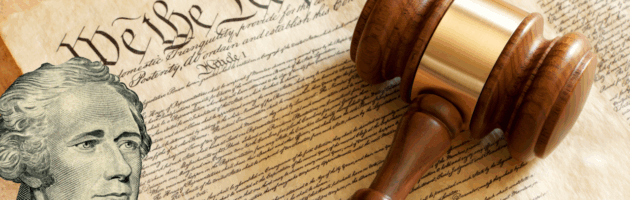
This lesson provides some suggestions for using The Federalist Papers that apply to the creation of the judiciary. Since the reading level of these essays is quite high, and the essay suggestions all involve reading one or more of The Federalist Papers, this activity will be quite challenging for most students.
Download the PDF
Corresponding Student Center Pages
Suggested Time Needed
2 class periods, with time outside of class to write essays
- Copies of The Federalist Papers, #78-83
- A: Small Group, Read and Summarize Activity on The Federalist Papers
This series of primary source activities will require students to read and analyze The Federalist Papers. After doing this assignment students will:
- Have a greater understanding of The Federalist Papers and their impact on the ratification debate for the Constitution.
- Comprehend the value of primary sources in understanding an historic argument.
- Comprehend the Federalists’ arguments pertaining to judicial appointment, life tenure of judges, the creation of inferior courts, judicial independence, and the opposing argument presented by Hamilton in The Federalist Papers.
- Be able to use the primary source documents noted to create a scholarly essay based on their interpretation of fact.
Guiding Questions
- What can The Federalist Papers, and specifically the essays about the federal courts, teach us about the intent of the founders when it came to the courts?
- What were the founders’ beliefs about why the members of the federal courts should be appointed and not elected? What did they believe the appointment of judges would ensure, or protect, the U.S. from? What was the “danger” inherent in electing judges?
- What is judicial independence, and why is it important?
Missouri Course Level Expectations
- 9-12.GV.3.CC.A – Explain how the central debates of the Constitutional Convention were resolved.
- 9-12.GV.3.CC.B – Explain how concerns over a strong central government were addressed to provide for the ratification of the Constitution.
Most of these activities are essay or discussion prompts. They could be edited to provide the foundation for a class debate, be used for assigning essays, or for general classroom discussion to tie a unit on the courts back to the Constitution. You’ll notice some of the arguments to which Hamilton was responding are still relevant today, such as those on the topic of judicial independence, judicial activism, and judicial review.
See the Teacher Fact Sheet for additional guidance on using the following activities with students.
Conclusion:
After completing one or more of these assignments, student should be able to answer the following:
- What are The Federalist Papers?
- Who was the primary author of those essays specifically devoted to the federal courts?
- What are any TWO of the main ideas that Hamilton makes in The Federalist Papers #78-83, about the federal courts?
Review the Guiding Questions:
- What can The Federalist Papers, and specifically the essays about the federal courts, teach us about the intent of the founders when it came to the courts?
- What were the founders’ beliefs about why the members of the federal courts should be appointed and not elected? What did they believe the appointment of judges would ensure, or protect, the U.S. from? What was the “danger” inherent in electing judges?
- What is judicial independence, and why is it important?
Activity 1: Small Group Read and Summarize Activity on Essay #78
For this activity, students will read and summarize Essay #78. They will be asked to use the 3 introductory points made by Hamilton to structure the summary. This will call on students to read and analyze the information, looking for relevant details under each point. Distribute A: Small Group, Read and Summarize Activity on The Federalist Papers.
Students might work alone or in groups, or begin alone then be asked to compare their responses with a partner or small group.
Activity 2: Essay and Discussion Ideas for The Federalist Papers #78- 83
The following essay prompts can be used to assign students an essay that asks them to read, analyze, and formulate an argument on an element from The Federalist Papers.
Students will need copies of The Federalist Papers, or should be provided with the links to find them online:
- The Federalist Papers at The Library of Congress: http://thomas.loc.gov/home/histdox/fedpapers.html
- The Federalist Papers at FoundingFather.info web page, full text, free: http://www.foundingfathers.info/federalistpapers/fedi.htm
Feel free to cut and paste the prompts into your own document, or onto your own web page so that you can add or remove elements. You may want to add essay guidelines that reflect your own writing and typing guidelines, or perhaps a grading rubric.
As an alternate assignment, the prompts could be used as a classroom discussion starters or debate questions.
Provide students with the appropriate document and prompt, and allow them time to read and reflect on the answers, then discuss or debate student responses in class.
Essay/Discussion Topic: Judicial Independence and The Federalist Papers #78
- One of the main themes in Hamilton’s Essay #78 is “judicial independence” or the necessity that the judicial branch be truly separate from the executive and legislative branches. How does Hamilton make this argument? Do you agree or disagree with him?
- The Constitution helped to ensure judicial independence, in part, by having judges be appointed instead of elected, and by giving them a life term. Using Federalist #78, explain Hamilton’s arguments for appointment of judges and life terms. Why did he think that these things made the judiciary more independent? Why was this independence so important according to Hamilton?
Essay/Discussion Topic: Judicial Review, The Federalist Papers #78
The Constitution does not directly give the federal courts the power of judicial review. This power was first used by the court in 1803 in the case of Marbury v. Madison.
However, in Federalist #78 Hamilton refers to the process when he states: “Some perplexity respecting the rights of the courts to pronounce legislative acts void, because contrary to the Constitution, has arisen from an imagination that the doctrine would imply a superiority of the judiciary to the legislative power.”
Read Federalist #78. Then, in a formal essay, describe Hamilton’s argument in SUPPORT of the power of judicial review. Be sure to:
- Define the term judicial review.
- Use specific examples (properly documented) from Federalist #78 to support your arguments.
Essay/Discussion Topic: Judicial power vs. the power of the other branches, The Federalist Papers #78
In the course of making his arguments in Federalist #78, Hamilton notes that “. . . the judiciary is beyond comparison the weakest of the three departments of power. . .” and that as such it can “never attack with success either of the other two.”
After reading Federalist #78, write a formal essay in which you explain the reasons that Hamilton gave in support of his claims above.
- You should also consider whether this statement rings true today, given changes in society (access to information, the media, etc.).
Essay/Discussion Topic: The tenure of federal judges and The Federalist Papers #78
In Federalist #78, Hamilton notes that one of the “weighty reasons” for the life term of federal judges is the “nature of the qualifications they require.” He goes on to explain that they must know a “voluminous code of laws.” He asserts that to “avoid an arbitrary discretion in the courts it is indispensable that they should be bound down by strict rules and precedents which serve to define and point out their duty in every particular case . . .”
In a formal essay, reflect on Hamilton’s words above and the subsequent argument he makes in Federalist #78. Then formulate an argument that considers the following questions:
- What does the amount of legal knowledge that judges possess have to do with the courts making consistent decisions?
- Why is this consistency in decision making so important in the federal judiciary? Or any courts for that matter?
- How does the life term of federal judges contribute to this consistency?
Essay/Discussion Topic: Compensation of federal judges and The Federalist Papers #79
In writing Federalist #79, Alexander Hamilton discusses the compensation of federal judges. After reading Federalist #79, write a formal essay in which you describe Hamilton’s argument for:
- How the payment of judges is different from that of the president or congress? Why it is acceptable to differentiate for judges?
- Be sure to explain clearly the differences in how these officials are paid.
- How are salary and the life term of judges linked? What argument does Hamilton make to show that, because judges serve a life term instead of a fixed one, their compensation should differ from the other branches?
Essay/Discussion Topic: The Federalist Papers #81
- In Federalist #81, Hamilton addresses Anti-Federalist arguments that the Supreme Court should be a part of the legislative branch. Read the document, and when you are finished write a formal essay in which you present Hamilton’s arguments AGAINST such inclusion. Why did he think it was a bad idea?
- In Federalist #81, Hamilton warns that putting the judicial function of government in the legislative branch, or putting the Supreme Court in the Congress, was a bad idea. In a brief essay, specifically describe the major problem that Hamilton saw with placing judges with “lifetime tenure” under the leadership of a Congress that served fixed terms. How did he see the amount of knowledge necessary for judges as a contributing factor in this argument?
- In Federalist #81, Hamilton speaks at length about the “original jurisdiction” of the Supreme Court. Why do you think he felt the need to give so much time to this issue? What “problems” might the Anti-Federalists have had with this particular power of the Court?
- Anti-Federalists argued that having “district courts” (federal courts that were placed within a state), would conflict with the jurisdiction of the state courts. What arguments does Hamilton make in Federalist #81 to counter these concerns?
Do You Know Your Bill of Rights?

Students will use the Judicial Learning Center website to identify rights that are found in the Bill of Rights. They will use the answers to solve the puzzle in this activity.
Download the PDF
Corresponding Student Center Pages
Suggested Time Needed
1 class period
- A: Do You Know Your Bill of Rights?
- B: Do You Know Your Bill of Rights? – Answer Key
After completing this activity, students will:
- Have a greater understanding of the rights and liberties presented in the Bill of Rights.
- Be able to identify the rights granted in the Bill of Rights, by Amendment.
Guiding Questions
- Why is the Bill of Rights so important?
- How would the United States be different if we did not have the rights that are listed in the puzzle?
Missouri Grade Level and Course Level Expectations
- 4.PC.1.C – Explain the major purposes of the Bill of Rights. Identify important principles in the Bill of Rights.
- 5.PC.1.C – Apply the principles of the Bill of Right to historical time period being studied and to current events.
- 6-8.AH.3.GS.F – Describe the origins and purposes of the Bill of Rights and evaluate the enduring significance of these concepts to the preservation of individual rights and liberties.
Place students into groups of 2, 3, or 4 depending on your class size and access to devices.
Instruct students to navigate their internet browsers to the page they will use: https://judiciallearningcenter.org/the-constitution-and-rights/
Distribute copies of A: Do You Know Your Bill of Rights?
Allow time to complete.
Conclusion
Go over the answers with the class. Ask these follow up questions:
- Do some of the amendments in the Bill of Rights seem more important than the others? Which ones and why?
- What are your 1st Amendment freedoms?
Review the Guiding Questions
- Why is the Bill of Rights so important?
- How would the United States be different if we did not have the rights that are listed in the puzzle?
Qualifications of Judges

In this two-part activity, students use primary source material to compare qualifications for holding public office and assess the qualities that make a good judge. Part 1 asks students to reflect on the constitutional requirements for holding a position in the legislative, executive and judicial branches. The activity will help students to compare the qualifications given in Article I and Article II of the U.S. Constitution for members of the legislative and executive branches, while noting the lack of such qualifications in Article III, and for the courts. Students are asked to consider what qualifications they might seek in a federal judge if they were president.
Part 2 asks students to write a “help wanted” advertisement for the United States Supreme Court. Students are asked to reflect on the qualities and skills that they think a Justice of the Supreme Court should have as they create their advertisement.
Corresponding Student Center Pages
Suggested Time Needed
2 class periods
A – Comparing Constitutional Qualifications
B – “Help Wanted” at the Supreme Court
After completing this activity, students will:
- Understand specific qualifications for the house, senate, and president.
- Understand that Article III of the Constitution fails to list any specific qualifications for federal judges.
- Begin to understand the “unwritten” qualifications that a president might seek in a federal judge.
- Be able to compare and contrast information to make conclusions.
Guiding Questions
- Why does the U.S. Constitution provide specific qualifications for members of the legislative and executive branches, but not for the courts?
- Does the fact that members of the legislative and executive branches are elected, while members of the judiciary are appointed, have something to do with the lack of specific qualifications for the judicial branch in the Constitution?
- What sort of qualities might a president seek in a candidate for the federal judiciary?
- Since there are no formal qualifications for members of the federal courts, the president must nominate people that he/she feels will be able to do the job well. What sort of qualities would you look for in a judge if you had to choose members of the Supreme Court?
- What is a job qualification?
- Are there any areas of specialized knowledge or information that someone should have to become a judge? If so, what?
Missouri Grade Level and Course Level Expectations
- 9-12.GV.1.CC.D – Using an inquiry lens, develop compelling questions to determine helpful sources and consider multiple points of view in the resources.
- 9-12.GV.4.GS.C – Compare the various processes pertaining to the selection of political leaders at the federal, state, and local level.
Part 1 - Constitutional Qualifications
Distribute the first handout and lead a discussion on the qualification of office for the legislative and executive branches, listed in Article I and Article II of the Constitution.
If time allows, you may direct students to review the related Student Center web pages:
- The Role of the Federal Courts; The Constitution
- Organization of the Federal Courts; About Federal Judges
Talking points:
Article I tells us that members of the House of Representatives must:
- Be at least 25 years of age
- Be a citizen of the United States for at least seven years
- Live in the state that elects them
Article I tells us that members of the Senate must:
- Be at least 30 years of age
- Be a citizen of the United States for at least nine years
- Live in the state that elects them
Article II tells us that the President must:
- Be at least 35 years of age
- Be a natural-born citizen of the United States
- Live in the United States for at least 14 years
Remind student that these are taken directly from the U.S. Constitution. To provoke thought, you might ask them:
- What is a “job qualification?”
- Do the qualifications listed in Article I and II refer to specific skills or job training?
- Should members of the executive and legislative branches possess certain job skills? What kind?
- Why would citizenship requirements be important when considering members of the legislative and judicial branches?
- This may be a good time to talk about natural-born citizenship vs. naturalized citizenship.
- Why, especially for members of congress, would residency requirements be important?
- Remind students that members of congress represent their state or congressional district and NOT the nation as a whole.
Remind students that Article III states:
“The judicial Power of the United States shall be vested in one supreme Court, and in such inferior Courts as the Congress may from time to time ordain and establish. The Judges, both of the supreme and inferior Courts, shall hold their Offices during good Behaviour, and shall, at stated Times, receive for their Services a Compensation, which shall not be diminished during their Continuance in Office.”
After this brief discussion, direct students to the bottom of the handout to complete the chart. They should identify some job qualifications for federal judges. This could be done individually, or in small groups.
Conclusion of Part 1. Have some students share their suggestions and discuss. Use some or all of the following questions to bring students back into the whole group setting, and to wrap things up:
- Do students see any similarities in the answers from one person or group to the next? What?
- What kinds of qualities did students think would be MOST important in a judge or Justice?
- Did students see the need for citizenship or residency requirements for judges? What about age limits? Why or why not?
- Did students see the need for federal judges to possess certain skills? Why might this be more important for judges than for members of the other branches?
- Since judges are appointed and NOT elected, is there really a need for specific job qualifications, or do citizens trust the president (and senate confirmation process) to choose good, qualified individuals for the courts?
- Do the students think that presidents have “unwritten qualifications,” that they look for in the judges they choose? Based on their answers, also ask what those qualifications might be.
Part 2 - What Makes a Good Judge?
After completing Part 1, transition to Part 2 by asking students:
- Do they think it’s a good idea that judges don’t have any specific qualifications listed in the Constitution? Why or why not?
- Why do they think the founders felt it was unnecessary to have specific qualifications for judges?
- Review – What qualities or qualifications do students think a judge should have?
Search for sample “Help Wanted” ads to display for your class.
Have students answer some basic questions about these ads:
- What job is the ad trying to fill?
- What, if any, qualifications are listed for this job?
- Is this job easier or more difficult than being a judge?
- Does this job require more or less education than being a judge?
Distribute the handout for Part 2. Ask students to think about creating a “Help Wanted” advertisement for a Supreme Court Justice. You may want to allow them to brainstorm for a few minutes or to work in groups so that they can bounce ideas off of one another.
Give students markers or colored pencils, and have each student or group create an ad to hand in. Allow time to work.
Conclusion of Part 2
Collect and share examples with the class. After students have shared their advertisements, use the following questions to guide a brief discussion and wrap up.
- Do students see any similarities in the ads from one group to the next? What?
- What kinds of qualities did students think would be MOST important in a Justice?
- Do the students think that presidents have “unwritten qualifications,” that they look in the judges and Justices they choose? Based on their answers, also ask what they might be.
- Why, then, might it be unnecessary for the Constitution to give specific qualifications?
Review the Guiding Questions
- Why does the U.S. Constitution provide specific qualifications for members of the legislative and executive branches, but not for the courts?
- Does the fact that members of the legislative and executive branches are elected, while members of the judiciary are appointed, have something to do with the lack of specific qualifications for the judicial branch in the Constitution?
- What sort of qualities might a president seek in a candidate for the federal judiciary?
- Since there are no formal qualifications for members of the federal courts, the president must nominate people that he/she feels will be able to do the job well. What sort of qualities would you look for in a judge if you had to choose members of the Supreme Court?
- What is a job qualification?
- Are there any areas of specialized knowledge or information that someone should have to become a judge? If so, what?
Visit the Student Center and Educator Center pages on “The Role of the Federal Courts.” Complete the lesson plan Separation of Powers/Qualifications of Office.
 Federal Courts in the News
- Opinion | The liberal judicial ‘resistance’ lives - The Washington PostOpinion | The liberal judicial ‘resistance’ lives The Washington Post
- Costco seeks 'full refund' for tariffs in new lawsuit against Trump administration - ABC NewsCostco seeks 'full refund' for tariffs in new lawsuit against Trump administration ABC News
- Street preacher asks Supreme Court to allow his lawsuit to move ahead - Atlanta News FirstStreet preacher asks Supreme Court to allow his lawsuit to move ahead Atlanta News First
- Meta Can't Force Advertisers To Arbitrate Claims Over Inflated Metrics 12/04/2025 - MediaPostMeta Can't Force Advertisers To Arbitrate Claims Over Inflated Metrics 12/04/2025 MediaPost
Copyright © 2019 The Judicial Learning Center. All rights reserved.
***External links are provided throughout the site for informational purposes only.
The Judicial Learning Center is not responsible for content on external sites.