


The Bill of Rights and Civil Liberties

This lesson helps students compare their state constitution with the Constitution of the United States. Students will specifically look at the fundamental rights guaranteed by the Constitution in an attempt to find these same rights in the constitution of their state.
Corresponding Student Center Pages
Suggested Time Needed
1-2 class periods
- The United States Constitution
- The State Constitution
- A: Bill of Rights Fact Sheet
- B: Comparing State and Federal Constitutions
After completing this activity, students will gain an understanding of the following:
- The powers and limits of the national government as outlined in the U.S. Constitution.
- The application of the Bill of Rights to both state and national governments.
- Constitutions, both state and federal, have safeguards to protect and preserve individual rights.
Students will also:
- Read and use the U.S. Constitution and state constitution as primary source documents.
- Read and evaluate the information they find in the documents and use this information to answer questions based on their reading.
Guiding Questions
- Do the states guarantee the same civil rights and liberties in their constitutions as the Constitution of the United States guarantees to all citizens?
- What would happen if the U.S. Constitution did not define civil liberties? Would the states make sure that people got their rights?
- Does the fact that most states have a Bill of Rights in their own Constitution mean that state governments are more or less likely to usurp peoples’ basic liberties?
Missouri Grade Level and Course Level Expectations
- 6-8.AH.3.GS.F – Describe the origins and purposes of the Bill of Rights and evaluate the enduring significance of these concepts to the preservation of individual rights and liberties.
- 9-12.GV.3.CC.D – Analyze the changing relationship between state and federal governmental powers.
- 9-12.GV.3.GS.E – Explain how the Bill of Rights and subsequent amendments limit the power of government, protect individual liberty, and provide for equality under the law.
- 9-12.GV.3.GS.F – Compare the structure and function of local, state and federal governments.
Lead an introductory discussion on the Bill of Rights. Students will need to know the following terms (which can be found in the Judicial Learning Center Glossary):
- Bill of Rights
- Incorporation
- Precedent
- Civil rights
- Civil liberties
- Due process
Remind students that most of our fundamental rights, due process rights, and civil liberties are defined in the Bill of Rights to the U.S. Constitution. This includes such things as:
- Our basic freedoms of religion, speech, press, petition and assembly.
- Our right to a trial by jury.
- Our right to have a lawyer present at trial.
- Our right to be free from illegal search and seizure.
- And more . . . . .
After reviewing some of these basic ideas, remind your students that the original text of the Constitution states that CONGRESS is limited by the Bill of Rights. It does not appear to also limit the state legislatures.
Note: Article VI of the Constitution requires that members of the congress, members of the state legislatures, as well as judicial and executive officers of both the national and state governments take an oath to support the U.S. Constitution, so it may presume that these officials at all levels and branches will uphold the Constitution. If the document did not make it clear that the rights implied by the Bill of Rights had to be applied on all levels, do you think state officials would feel bound to do so?
Use the concept above as a discussion starter by asking your students if they believe that the states would agree to give people rights if the U.S. Constitution did not make them do so. You might remind students that the 14th Amendment has been used to apply the Bill of Rights to the states, but would states have to “incorporate” the rights alluded to in the Constitution if the 14th Amendment did not exist?
The activity that follows will ask students to think about what would happen IF the states did not have to comply with the Constitution.
Distribute A: Bill of Rights Fact Sheet, and B: Comparing the State and Federal Constitutions.
Students will also need a copy of the United States Constitution and their state’s constitution to complete the study guide. The links for these are provided below and are also included on the student handout.
- The state constitution is generally available at the Secretary of State’s Office in your state. For Missouri you can access the document at: https://revisor.mo.gov/main/Home.aspx?constit=y
- Or, a PDF copy of the Missouri Constitution from the Secretary of State’s Office can be found here: https://www.sos.mo.gov/pubs/constitution
- As a teacher, you can ask for a paper copy of the Missouri Constitution from the Secretary of State’s Office. They will send these to you free of charge, if you want to create a classroom set. You can find information about how to obtain such copies from the link below: http://www.sos.mo.gov/pubs/constitution.asp
Allow time to complete the study guide. It could be assigned for homework or could be done in class as either an individual, partner, or group activity.
Some things to point out as your students begin:
- They should note the length of the state constitution in comparison to the Constitution of the U.S. Which is longer?
- They should note the organization of each document. Is one easier to navigate than other? What makes this true or not?
- They should note the number of amendments to each. Generally, the amendment process is simpler at the state level which means that most state constitutions are amended more. The Constitution has only been changed 27 times in over 200 years. How many amendments does your state constitution have?
- This might afford you an opening to talk about initiative/petition and the ability of voters on the state level to force the addition of material into the state constitution and into state law.
- The study guide asks students to skim through the state constitution looking for similarities to the U.S. Constitution. Students will generally find that the Missouri Constitution does mirror that of the federal government when it comes to rights and civil liberties.
- If you aren’t working with the Missouri Constitution you may still see that most state constitutions contain a Bill of Rights, or include many of the rights granted to Americans at the national level.
Conclusion
After students finish the study guides, go over answers with them. Then, use the questions below for a post-study guide discussion.
- What do you think it means that the Missouri Constitution includes many of the same rights as the U.S. Constitution?
- What would happen if those rights were ONLY found in the state constitution or if they were ONLY in the national Constitution? Why might it be a problem?
- Would we as citizens still get the rights listed in the U.S. Constitution if states were not forced to incorporate them?
- Could our respective states pick and choose which rights to grant their residents?
- Do you think there are some rights that states might prefer to ignore? Which ones? Why?
Review the Guiding Questions
- Do the states guarantee the same civil rights and liberties in their constitutions as the Constitution of the United States guarantees to all citizens?
- What would happen if the U.S. Constitution did not define civil liberties? Would the states make sure that people got their rights?
- Does the fact that most states have a Bill of Rights in their own Constitution mean that state governments are more or less likely to usurp peoples’ basic liberties?
Article III Webquest

This WebQuest is designed to walk students through Article III of the Constitution by examining primary source material as well as the interpretive information on the Judicial Learning Center website. The activity can be completed using the printable worksheet, or virtual form. Students will need the ability to access the Judicial Learning Center website.
Download the PDF
Corresponding Student Center Pages
Suggested Time Needed
1 class period
- A: Article III WebQuest
- OR Virtual WebQuest – Use the template to create your own form to share with your students
After completing this activity, students will:
- Have a greater understanding of the content found in Article III.
- Begin to build the vocabulary necessary to understand Article III.
- Understand the jurisdiction of the federal courts.
Guiding Questions
- Which article of the U.S. Constitution talks about the federal courts?
- Does Article III explain the appointment process for federal judges?
- What kind of power is vested in the courts, according to Article III?
- What is treason?
- What are TWO areas over which the federal courts have jurisdiction?
Missouri Grade Level and Course Level Expectations
6-8
- 6-8.AH.3.GS.E – Apply the principles of rule of law, representation, separation of powers, checks and balances, and federalism to explain the purposes and functions of the Constitution.
9-12
- 9-12.GV.3.GS.C – Analyze the unique roles and responsibilities of the three branches of government to determine how they function and interact.
- 9-12.GV.3.GS.F – Compare the structure and functions of local, state, and federal governments.
- 9-12.GV.4.GS.C – Compare the various processes pertaining to the selection of political leaders at the federal, state, and local level.
Explain to students that although Article III is the shorter than Articles I or II, it is still very important.
Place students into groups of 2, 3, or 4 depending on your class size.
Instruct students to navigate their internet browsers to the page they will use:
- Student Center page – Article III and the Courts
- A suitable online dictionary
Distribute copies of A: Article III WebQuest.
Allow time to complete.
Conclusion
Go over the WebQuest responses with the class.
Review the Guiding Questions
- Which article of the U.S. Constitution talks about the federal courts?
- Does Article III explain the appointment process for federal judges?
- What kind of power is vested in the courts, according to Article III?
- What is treason?
- What are TWO areas over which the federal courts have jurisdiction?
Section 2 of Article III, detailing the jurisdiction of the federal courts, often causes confusion in students. Useful follow up activities can be found by visiting the Student Center and Educator Center pages:
- State Courts vs. Federal Courts
- Types of Court Cases
- Complete the lesson plan Understanding the Types of Cases
The Federalist Papers and the Federal Judiciary
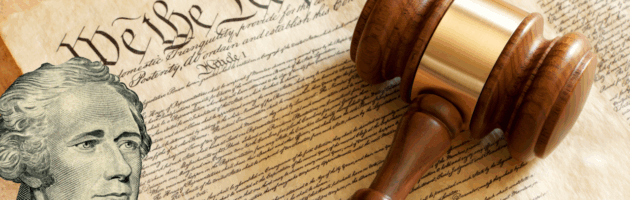
This lesson provides some suggestions for using The Federalist Papers that apply to the creation of the judiciary. Since the reading level of these essays is quite high, and the essay suggestions all involve reading one or more of The Federalist Papers, this activity will be quite challenging for most students.
Download the PDF
Corresponding Student Center Pages
Suggested Time Needed
2 class periods, with time outside of class to write essays
- Copies of The Federalist Papers, #78-83
- A: Small Group, Read and Summarize Activity on The Federalist Papers
This series of primary source activities will require students to read and analyze The Federalist Papers. After doing this assignment students will:
- Have a greater understanding of The Federalist Papers and their impact on the ratification debate for the Constitution.
- Comprehend the value of primary sources in understanding an historic argument.
- Comprehend the Federalists’ arguments pertaining to judicial appointment, life tenure of judges, the creation of inferior courts, judicial independence, and the opposing argument presented by Hamilton in The Federalist Papers.
- Be able to use the primary source documents noted to create a scholarly essay based on their interpretation of fact.
Guiding Questions
- What can The Federalist Papers, and specifically the essays about the federal courts, teach us about the intent of the founders when it came to the courts?
- What were the founders’ beliefs about why the members of the federal courts should be appointed and not elected? What did they believe the appointment of judges would ensure, or protect, the U.S. from? What was the “danger” inherent in electing judges?
- What is judicial independence, and why is it important?
Missouri Course Level Expectations
- 9-12.GV.3.CC.A – Explain how the central debates of the Constitutional Convention were resolved.
- 9-12.GV.3.CC.B – Explain how concerns over a strong central government were addressed to provide for the ratification of the Constitution.
Most of these activities are essay or discussion prompts. They could be edited to provide the foundation for a class debate, be used for assigning essays, or for general classroom discussion to tie a unit on the courts back to the Constitution. You’ll notice some of the arguments to which Hamilton was responding are still relevant today, such as those on the topic of judicial independence, judicial activism, and judicial review.
See the Teacher Fact Sheet for additional guidance on using the following activities with students.
Conclusion:
After completing one or more of these assignments, student should be able to answer the following:
- What are The Federalist Papers?
- Who was the primary author of those essays specifically devoted to the federal courts?
- What are any TWO of the main ideas that Hamilton makes in The Federalist Papers #78-83, about the federal courts?
Review the Guiding Questions:
- What can The Federalist Papers, and specifically the essays about the federal courts, teach us about the intent of the founders when it came to the courts?
- What were the founders’ beliefs about why the members of the federal courts should be appointed and not elected? What did they believe the appointment of judges would ensure, or protect, the U.S. from? What was the “danger” inherent in electing judges?
- What is judicial independence, and why is it important?
Activity 1: Small Group Read and Summarize Activity on Essay #78
For this activity, students will read and summarize Essay #78. They will be asked to use the 3 introductory points made by Hamilton to structure the summary. This will call on students to read and analyze the information, looking for relevant details under each point. Distribute A: Small Group, Read and Summarize Activity on The Federalist Papers.
Students might work alone or in groups, or begin alone then be asked to compare their responses with a partner or small group.
Activity 2: Essay and Discussion Ideas for The Federalist Papers #78- 83
The following essay prompts can be used to assign students an essay that asks them to read, analyze, and formulate an argument on an element from The Federalist Papers.
Students will need copies of The Federalist Papers, or should be provided with the links to find them online:
- The Federalist Papers at The Library of Congress: http://thomas.loc.gov/home/histdox/fedpapers.html
- The Federalist Papers at FoundingFather.info web page, full text, free: http://www.foundingfathers.info/federalistpapers/fedi.htm
Feel free to cut and paste the prompts into your own document, or onto your own web page so that you can add or remove elements. You may want to add essay guidelines that reflect your own writing and typing guidelines, or perhaps a grading rubric.
As an alternate assignment, the prompts could be used as a classroom discussion starters or debate questions.
Provide students with the appropriate document and prompt, and allow them time to read and reflect on the answers, then discuss or debate student responses in class.
Essay/Discussion Topic: Judicial Independence and The Federalist Papers #78
- One of the main themes in Hamilton’s Essay #78 is “judicial independence” or the necessity that the judicial branch be truly separate from the executive and legislative branches. How does Hamilton make this argument? Do you agree or disagree with him?
- The Constitution helped to ensure judicial independence, in part, by having judges be appointed instead of elected, and by giving them a life term. Using Federalist #78, explain Hamilton’s arguments for appointment of judges and life terms. Why did he think that these things made the judiciary more independent? Why was this independence so important according to Hamilton?
Essay/Discussion Topic: Judicial Review, The Federalist Papers #78
The Constitution does not directly give the federal courts the power of judicial review. This power was first used by the court in 1803 in the case of Marbury v. Madison.
However, in Federalist #78 Hamilton refers to the process when he states: “Some perplexity respecting the rights of the courts to pronounce legislative acts void, because contrary to the Constitution, has arisen from an imagination that the doctrine would imply a superiority of the judiciary to the legislative power.”
Read Federalist #78. Then, in a formal essay, describe Hamilton’s argument in SUPPORT of the power of judicial review. Be sure to:
- Define the term judicial review.
- Use specific examples (properly documented) from Federalist #78 to support your arguments.
Essay/Discussion Topic: Judicial power vs. the power of the other branches, The Federalist Papers #78
In the course of making his arguments in Federalist #78, Hamilton notes that “. . . the judiciary is beyond comparison the weakest of the three departments of power. . .” and that as such it can “never attack with success either of the other two.”
After reading Federalist #78, write a formal essay in which you explain the reasons that Hamilton gave in support of his claims above.
- You should also consider whether this statement rings true today, given changes in society (access to information, the media, etc.).
Essay/Discussion Topic: The tenure of federal judges and The Federalist Papers #78
In Federalist #78, Hamilton notes that one of the “weighty reasons” for the life term of federal judges is the “nature of the qualifications they require.” He goes on to explain that they must know a “voluminous code of laws.” He asserts that to “avoid an arbitrary discretion in the courts it is indispensable that they should be bound down by strict rules and precedents which serve to define and point out their duty in every particular case . . .”
In a formal essay, reflect on Hamilton’s words above and the subsequent argument he makes in Federalist #78. Then formulate an argument that considers the following questions:
- What does the amount of legal knowledge that judges possess have to do with the courts making consistent decisions?
- Why is this consistency in decision making so important in the federal judiciary? Or any courts for that matter?
- How does the life term of federal judges contribute to this consistency?
Essay/Discussion Topic: Compensation of federal judges and The Federalist Papers #79
In writing Federalist #79, Alexander Hamilton discusses the compensation of federal judges. After reading Federalist #79, write a formal essay in which you describe Hamilton’s argument for:
- How the payment of judges is different from that of the president or congress? Why it is acceptable to differentiate for judges?
- Be sure to explain clearly the differences in how these officials are paid.
- How are salary and the life term of judges linked? What argument does Hamilton make to show that, because judges serve a life term instead of a fixed one, their compensation should differ from the other branches?
Essay/Discussion Topic: The Federalist Papers #81
- In Federalist #81, Hamilton addresses Anti-Federalist arguments that the Supreme Court should be a part of the legislative branch. Read the document, and when you are finished write a formal essay in which you present Hamilton’s arguments AGAINST such inclusion. Why did he think it was a bad idea?
- In Federalist #81, Hamilton warns that putting the judicial function of government in the legislative branch, or putting the Supreme Court in the Congress, was a bad idea. In a brief essay, specifically describe the major problem that Hamilton saw with placing judges with “lifetime tenure” under the leadership of a Congress that served fixed terms. How did he see the amount of knowledge necessary for judges as a contributing factor in this argument?
- In Federalist #81, Hamilton speaks at length about the “original jurisdiction” of the Supreme Court. Why do you think he felt the need to give so much time to this issue? What “problems” might the Anti-Federalists have had with this particular power of the Court?
- Anti-Federalists argued that having “district courts” (federal courts that were placed within a state), would conflict with the jurisdiction of the state courts. What arguments does Hamilton make in Federalist #81 to counter these concerns?
Do You Know Your Bill of Rights?

Students will use the Judicial Learning Center website to identify rights that are found in the Bill of Rights. They will use the answers to solve the puzzle in this activity.
Download the PDF
Corresponding Student Center Pages
Suggested Time Needed
1 class period
- A: Do You Know Your Bill of Rights?
- B: Do You Know Your Bill of Rights? – Answer Key
After completing this activity, students will:
- Have a greater understanding of the rights and liberties presented in the Bill of Rights.
- Be able to identify the rights granted in the Bill of Rights, by Amendment.
Guiding Questions
- Why is the Bill of Rights so important?
- How would the United States be different if we did not have the rights that are listed in the puzzle?
Missouri Grade Level and Course Level Expectations
- 4.PC.1.C – Explain the major purposes of the Bill of Rights. Identify important principles in the Bill of Rights.
- 5.PC.1.C – Apply the principles of the Bill of Right to historical time period being studied and to current events.
- 6-8.AH.3.GS.F – Describe the origins and purposes of the Bill of Rights and evaluate the enduring significance of these concepts to the preservation of individual rights and liberties.
Place students into groups of 2, 3, or 4 depending on your class size and access to devices.
Instruct students to navigate their internet browsers to the page they will use: https://judiciallearningcenter.org/the-constitution-and-rights/
Distribute copies of A: Do You Know Your Bill of Rights?
Allow time to complete.
Conclusion
Go over the answers with the class. Ask these follow up questions:
- Do some of the amendments in the Bill of Rights seem more important than the others? Which ones and why?
- What are your 1st Amendment freedoms?
Review the Guiding Questions
- Why is the Bill of Rights so important?
- How would the United States be different if we did not have the rights that are listed in the puzzle?
 Federal Courts in the News
- Boasberg reverses course on Jan. 6 defendants pardoned by Trump - AOL.comBoasberg reverses course on Jan. 6 defendants pardoned by Trump AOL.com
- Opinion | The liberal judicial ‘resistance’ lives - The Washington PostOpinion | The liberal judicial ‘resistance’ lives The Washington Post
- Street preacher asks Supreme Court to allow his lawsuit to move ahead - Atlanta News FirstStreet preacher asks Supreme Court to allow his lawsuit to move ahead Atlanta News First
- Meta Can't Force Advertisers To Arbitrate Claims Over Inflated Metrics 12/04/2025 - MediaPostMeta Can't Force Advertisers To Arbitrate Claims Over Inflated Metrics 12/04/2025 MediaPost
Copyright © 2019 The Judicial Learning Center. All rights reserved.
***External links are provided throughout the site for informational purposes only.
The Judicial Learning Center is not responsible for content on external sites.